

 Tiktok failed to load.
Enable 3rd party cookies or use another browser
Have you noticed how quickly your feed adapts now?
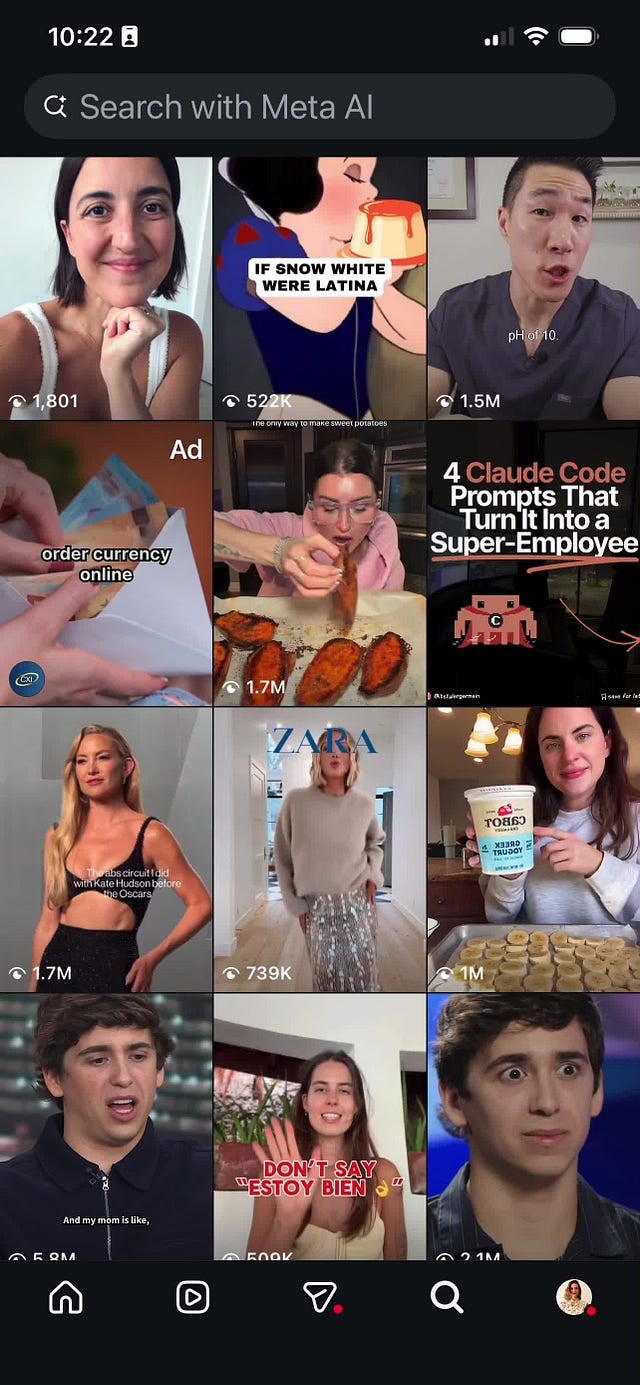
Search for something once on Instagram, and suddenly you’re in a loop of recommendations. For me it’s a steady stream of sweet potato recipes, zara hauls, and Marcello Hernandez clips.
Gary Vaynerchuk described this shift as the move from social media to interest media, where algorithms decide what you see based on what you engage with, not who you follow.
And in that world, something important changes:
Anyone can go viral.
Not because they have a large audience,
but because the system is designed to find and distribute content that performs.
That’s the opportunity. But it’s only half the story.
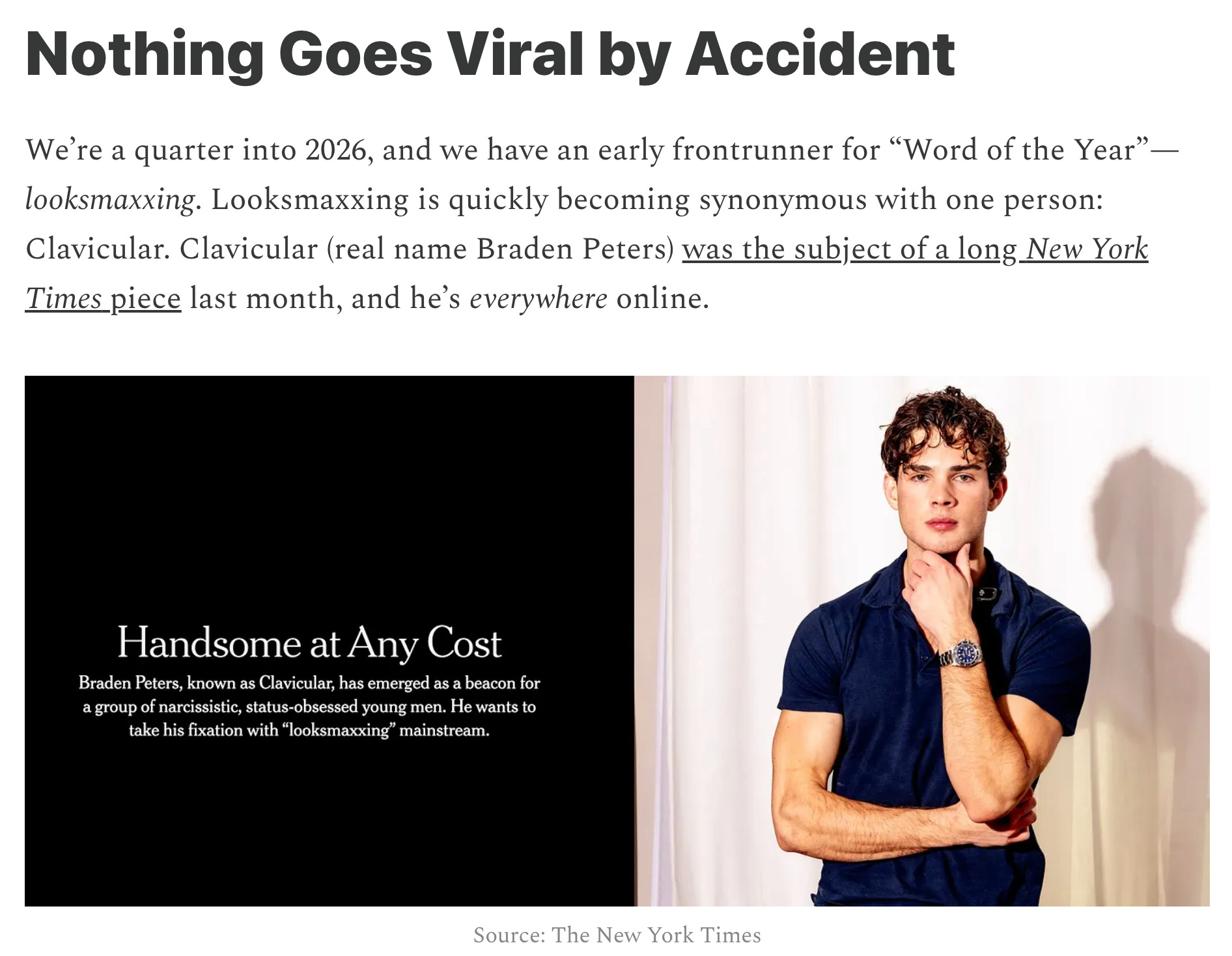
In his latest Digital Native essay, “Nothing Goes Viral by Accident,” Rex Woodbury explores what’s happening behind the scenes.
👉 https://www.digitalnative.tech/p/nothing-goes-viral-by-accident
Because virality isn’t just being discovered anymore.
It’s increasingly being engineered.
He points to the rise of creators like Clavicular—and the ecosystem powering that growth.
A big part of it is something called clipping: turning long-form content into short, highly shareable moments designed for distribution.
“Arguably the most prolific clipper is MrBeast, who reportedly employs more than a thousand clippers, paying $50 for every 100,000 views that videos receive.”
If interest media expands who can go viral, clipping increases the odds that something will.
What used to feel like organic reach is now a mix of:
algorithmic distribution
engineered amplification
And once you see it, you start to understand:
Virality is no longer just about creativity.
It’s about the quality of your content and how well it fits the system.
🧠 What this means for creators
This shift changes the game.
In the social media era:
→ you built an audience
In the interest media era:
→ you build signals
What matters now isn’t:
how many followers you have
or even how often you post
It’s:
what people watch
what they save
what they share
how long they stay
Because those signals determine whether your content gets traction and distribution.
And increasingly, those systems are being optimized automatically at scale.
👉 https://www.businessinsider.com/ai-powered-ads-driving-us-ad-growth-madison-wall-2026-3
🔄 The new creator playbook
The creators who win in this system don’t just post.
They iterate and test ideas. They watch what performs and adapt quickly.
And they understand something most people miss:
You don’t need one viral post.
You need a system that can produce, learn, and improve continuously.
🧰 The tools making this possible
A new layer of tools is emerging — not to replace creators, but to accelerate learning:
Platforms like Buffer help you track what actually performs — turning content into measurable signals
👉 https://buffer.com/resources/ai-social-media-content-creation/Tools like Notion AI turn your past posts into a searchable system — helping you spot patterns over time
And AI assistants built into platforms now make it easier to test multiple variations quickly — so you can learn what works faster
Together, they don’t just help you create.
They help you see what’s working — and do it again, better.
Would be curious to know, what tool stack do you currently use to optimize your creative content?