


I spent part of this week in New York - bike riding in Central Park, watching a Broadway show, and soaking up the city in full bloom. And then, completely by accident, stumbled upon a robocar in Times Square.
It was Tensor Auto, described as the world’s first personal “robocar.” A luxury vehicle designed to drive itself while you sit back and do something else. You own it. The AI handles the driving. Does anyone else feel like tech just keeps on moving faster and faster?
What caught my attention wasn’t the car. It was the strategy. For years, the AI conversation has centered on platforms, shared services, marketplaces, one-size-fits-all tools. Tensor is betting on the opposite: AI embedded into something personal, something that works quietly on your behalf. It’s the difference between a tool you operate and one that operates for you. And that gap is closing fast.
That same logic played out in my own workflow this week. I’ve been on a building spree, automating everything I can in my content business. This week it was ManyChat. I’d always wondered what actually happens when you comment a word on someone’s post and automatically get a DM. So I built it myself to find out.
Here’s what’s going on: someone comments a keyword, like REPORT (that’s the one I used to test it out). ManyChat detects it, fires an automatic DM, a link, a freebie, whatever you want to send. Then follows up to capture their email. Every comment boosts the algorithm. Every DM captures a lead. Engagement and list building at the same time.
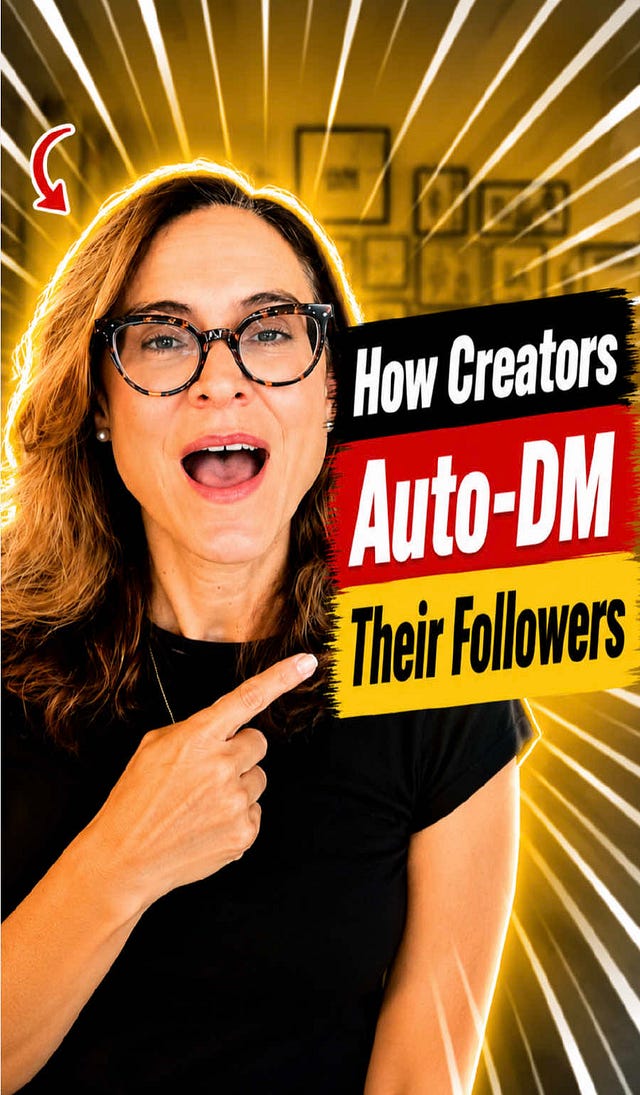
 Tiktok failed to load.
Enable 3rd party cookies or use another browser
I set mine up this week. 20 people triggered it in 24 hours. Worked perfectly, now I’m just optimizing the email capture step.
A robocar in Times Square. A comment automation that runs 24/7. That’s the story this week: automation is everywhere. But so are the cracks. Let’s get into it.
AI & TOOLS
AI Prompts That Tripled a Business’s Revenue
💡 Why this matters A solopreneur leveraged just four AI prompts to achieve a significant revenue increase in 12 months, without external funding or a team. Check out the power of strategic AI integration for small businesses.
PLATFORM UPDATES
Google Ordered to Clarify AI Search Links, Allow UK Publishers to Opt Out
💡 Why this matters If you create content, this one’s worth watching even if you’re not in the UK. When publishers can opt out of AI-generated summaries, it changes how your content surfaces in search and forces a real question: do you want visibility inside AI answers, or would you rather drive traffic the old-fashioned way? The rules around content attribution are being written right now.
AI & TOOLS
The Meta Hack: AI Customer Support Exploited for Account Theft
💡 Why this matters Hackers got Meta’s AI support agent to hand over Instagram accounts just by asking nicely. No sophisticated breach required. For creators, the lesson is simple: multi-factor authentication on everything, always. And if you’re building any kind of AI tool for customer interaction, this is a preview of how it can be weaponized if you skip the security layer.
AI & TOOLS
Amazon Rolls Out Voice-Activated Warehouse Robots
💡 Why this matters Amazon’s warehouse workers can now just talk to the robots. No special commands, no training — just natural language. This is what ‘human-robot collaboration’ actually looks like in practice, and it’s moving faster than most people realize. For creators building in the AI space, it’s a reminder: the interfaces that win are the ones that feel effortless.
🎯 Your Edge This Week
This week, set up one comment-trigger automation, ManyChat has a free tier. Pick a piece of content you’re already posting, attach a keyword, and send something useful to whoever comments. Even 5 people triggering it will teach you more about your audience than a week of analytics.
📊 This Week’s Big Patterns
Pattern 1: The ‘More AI’ Bill Has Arrived
The first wave of AI adoption was ‘yes, and.’ Yes, use it. And use more of it. That phase is over. Companies are now actively reining in AI usage because the costs are real — and the returns aren’t always matching. At the same time, businesses are getting smarter: instead of defaulting to the biggest, most expensive models, they’re building custom, cheaper tools that do one specific job really well. The question has shifted from ‘are we using AI?’ to ‘is our AI use actually paying off?’
🔮 Prediction: We’ll see a wave of ‘AI auditing’ services emerge in the next 12 months — consultants whose sole job is helping companies figure out where AI is wasting money and swap expensive models for cheaper, purpose-built ones.
❓ Ask yourself: Are you using the most powerful AI tool out of habit, or because it’s genuinely the right tool for the job?
Pattern 2: The Trust Layer Is Cracking
AI tools are getting more powerful — and more hackable. Hackers didn’t need to breach Meta’s systems; they just asked the AI customer support agent politely and got access to Instagram accounts. Meanwhile, Google is being forced to give publishers more control over how their content appears in AI search. The bottleneck for AI adoption isn’t capability anymore. It’s trust: can users trust the AI won’t be manipulated? Can creators trust their content will be attributed correctly? These are the questions platforms are scrambling to answer.
🔮 Prediction: Within the next six months, a major platform will experience a high-profile breach where an AI agent is tricked into giving sensitive access to the wrong person. It will accelerate a whole new category of ‘AI security’ tools.
❓ Ask yourself: If someone tried to socially engineer your AI tools today, would they get in? Have you actually tested it?
Pattern 3: Real-World Wins Are Beating Digital Impressions
As AI floods the internet with generated content, something interesting is happening: the things that can’t be faked are becoming more valuable. Amazon workers talking to robots. Creators building in-person experiences that turn into content. Brands discovering that a physical activation drives more real engagement than a digital campaign. When AI can summarize your entire online presence in one sentence, the question becomes: what experience do you offer that forces someone to actually show up?
🔮 Prediction: Live, in-person engagement will become the primary KPI for premium brand campaigns. Not impressions, not clicks — proof that a real human showed up and participated.
❓ Ask yourself: If AI could summarize everything you do online into one paragraph, what would make someone still want to meet you in person?
See you next week! — Ka